
 The Public Humanities Exchange program (HEX and HEX-U) at the UW-Madison Center for the Humanities funds innovative public humanities projects that forge partnerships between community organizations and UW-Madison students.
The following blog post is written by HEX-U Scholar Kaylin Vang. Vang’s project, “Cultivating Connections”, is a mentorship framework that empowers Asian American college students to support high school students in navigating the complexities of cultural identity. Cultivating Connections aims to nurture a sustainable, community-rooted model for identity exploration.
Cultivating Connections: Building Community Through Conversation
When Cultivating Connections first started in 2024, the goal was simple: create the kind of space that gave Asian high school students the tools to discuss their identity and how it plays a role in their day-to-day experiences and community. The idea began with Ms. Her, a teacher at Madison West High School and advisor for their Asian Student Union. Over time, she noticed that opportunities for meaningful engagement were limited and that students didn’t always have spaces to talk openly about identity beyond occasional club meetings and fundraisers. Ms. Her imagined something different, a space where high school students could connect with college students who shared similar backgrounds and experiences and have conversations that felt honest, relevant, and personal.
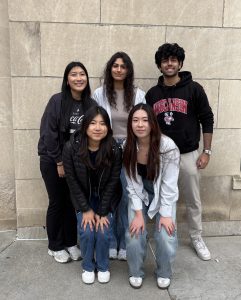
That vision eventually became Cultivating Connections after she reached out to UW–Madison’s Asian American Student Union (AASU) and connected with Amber Chang, Angelica Chang, Max Hsu, and Maisha Islam. Together, they built a program through the Wisconsin Idea Fellowship (WIF) centered on conversation, reflection, and community.
Cultivating Connections was created to fill a gap. While many students had support systems among their family, teachers, and friends, there was something uniquely valuable about connecting with mentors who had recently gone through similar experiences: people who understood what it felt like to grow up in Madison while navigating Asian identity. Those conversations created opportunities for students to ask questions, share experiences, and feel seen in ways that traditional mentorship spaces do not always allow.
I joined Cultivating Connections as a mentor during its first year and quickly realized that the impact went both ways. While students gained new perspectives and connections, I found myself growing too. Facilitating discussions, creating welcoming environments, and hearing students share their stories challenged me to become a better listener and leader. During our first year, conversations focused heavily on Asian identity through topics like regional identity, the model minority myth, intersectionality, and colorism. With the support of the Center for the Humanities’ HEX program, our leadership team started thinking about how to expand our program while staying true to our original mission. We successfully worked with 15 mentors and 15 mentees over the course of the academic year.
This year, we developed a second curriculum that encouraged students to think more deeply about both identity and relationships. Discussions explored topics like Asian and Pacific Islander identities, ethnic homophily, immigration and language barriers, intergenerational relationships, leadership within Asian American communities, and mental health stigma. One change that reflected the success of the program was something small but meaningful. We added another discussion meeting. Last year, students and mentors met three times. This year, we met four, simply because people wanted more time together. Those lunches became more than scheduled discussions. They became spaces where conversations continued naturally over food, stories, and shared experiences.
We also brought back traditions from the previous year, including our kickoff event featuring Squid Game-inspired activities. The games helped break down barriers and made it easier for mentors and mentees to interact as peers rather than formal mentor-mentee pairs. Toward the end of the year, students joined us for a food crawl across UW–Madison. As we visited different spots and tried cuisines ranging from Chinese and Korean to Taiwanese food, conversations about identity and belonging continued outside the structure of our usual meetings.
This year, we also tried something entirely new. For the first time, mentors and mentees attended a university lecture together: Asian American Studies 462: Asian American Graphic Novels and Comics, taught by Professor Timothy Yu. Students read selections from Roaming by Jillian and Mariko Tamaki, sat in on discussion, and then reflected together afterward. Watching high school students step into a college classroom and participate in conversations about Asian American identity felt especially meaningful. It gave students an opportunity to imagine themselves in those spaces and see that these conversations don’t stop after graduation.
Another new addition was our spring workshop, Affluence and Influence, hosted in collaboration with AASU. Instead of only talking about inequality, students experienced it. Through rotating activities, groups were given different levels of access to resources while completing the same tasks. Facilitators intentionally created unequal conditions to simulate broader social and economic disparities. The reflections afterward were some of the most thoughtful conversations we had all year.
One of my favorite moments was noticing how naturally students participated. Sometimes when talking about such complex topics extra encouragement is needed to get started. This time, students jumped in immediately. They shared openly, asked questions, and stayed engaged throughout. In general, one student shared, “I found the program as a safe space to openly discuss my Asian identity. I found it really comforting to be able to talk about my experiences.”
Looking back, Cultivating Connections became much more than a mentorship program. It became a place where students could explore identity, challenge assumptions, and build relationships rooted in shared experiences. More than anything, it reminded me that meaningful community work starts with people who are willing to show up authentically, and create space for others to do the same.