
 The Public Humanities Exchange program (HEX and HEX-U) at the UW-Madison Center for the Humanities funds innovative public humanities projects that forge partnerships between community organizations and UW-Madison students.
The following guest blog post, written by recent HEX Scholar Mia Hicks (PhD candidate, Curriculum and Instruction) highlights how she engaged students and teachers in a Spanish bilingual program with a social emotional learning unit that emphasizes care and justice as ways to support themselves, their communities, and beyond. Hicks’ project uplifts the Latinx cultural value of care, cariño, which emphasizes nurturing relationships between education, community and family.
Cariño and Community: Researchers and Teachers Collaboratively Reimagining Social Emotional Learning Through Latinx Cultural Values of Care
In August 2025, teachers Ms. O’Brien and Maestra Ortiz and I sat together at a public library, excitedly working through a large book list of picture books about justice and care. The list included over fifty wonderful picture books that featured topics related to care, justice, and Latinx culture. We had been working all summer to co-design a social emotional learning (SEL) unit for the teacher’s upcoming school year for first grade students in Woodlawn Elementary’s Spanish/English bilingual program. Each step of our co-design was rooted in collectivity and strengthened our shared commitment to reimagining SEL. We began by reflecting on our own experiences teaching SEL in an elementary bilingual classroom, reviewing past instructional choices to best consider how we could design lessons that centered care and uplifted Latinx cultural values. Specifically, we rooted our lessons in cariño, a Latinx cultural form of care that emphasizes nurturing and authentic relationships between education, community, and family. From here, we decided on four themes that we would create SEL lessons around, including: “I care for myself,” “We care for others,” “We care for our community,” and “We care for justice.”
Fast forward to November 2025 in a first-grade classroom at Woodlawn Elementary School. Ms. O’Brien, Maestra Ortiz, and I were gathered around a colorful rainbow rug with 30 excited first graders. Last fall, we were transitioning from lessons in “We care for our community” to “We care for justice” when the Trump administration announced that the Supplemental Nutrition Assistance Program (SNAP) would run out of money during the government shutdown, affecting over 40 million people who receive financial assistance toward food and nutrition benefits. Given recent events, the teachers and I thought it was important for us to explore how the school community expresses cariño and justice by taking a trip to the school’s food pantry that serves families in the local community.
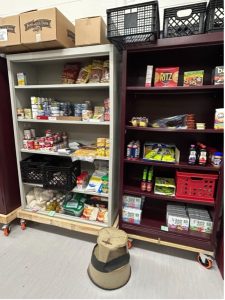 Before heading to the food pantry, we watched a video that explained food insecurity and what a food pantry is. Some students, like Rose, made connections; his dad had just dropped off extra paper bags and funds at the pantry. Other students asked questions, such as if the food was free and whether their families could visit too. Maestra Ortiz shared that families could contact Ms. G, the school’s bilingual family liaison, to set up their own private shopping experience. Students chatted excitedly as we walked down the hallway to the school food pantry. The food pantry was small, with a variety of school and office style cabinets and two refrigerators holding canned goods, rice, household supplies, and even perishable items like milk and meat. Students asked about the process of picking food, how much food you could take, and how often families could visit.
After our visit to the food pantry, we had a conversation about what we learned. Students shared details about the small size and noted how clean the floors were. Other students remarked on the ways in which food is brought to the pantry (thanks to community partnerships and the hard work of Ms. G). During our visit, Ms. G told our class that because of the small space, and the generosity of the community bringing in extra food to prepare for the SNAP benefits to be frozen, the food pantry didn’t have enough room for more food donations. One student, Piper, suggested adding toy donations. During co-design, the teachers and I had planned that after the four themes of lessons, students could do an activist project. We thought one project could be creating care packages with hygiene items, but Piper reminded us that we should incorporate items beyond basic needs. She was thinking about what children and families in her own community were experiencing. Piper shared that beyond food, children also deserve to have child-centered items like toys, even comparing it to the joy of presents. In doing so, Piper demonstrated cariño as she dismantled the notion that people and children who access government assistance would be undeserving of gifts of non-necessities, like toys. Instead, she affirmed the stance of Article 31 in the Convention on the Rights of the Child, that all children have the right to play and participate freely in culture and the arts (United Nations, 1989).
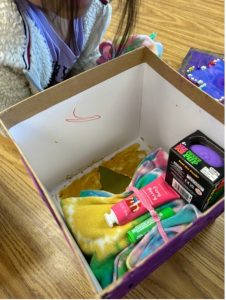 Piper’s suggestion ultimately influenced one of the final activist projects that students engaged in. One group decided to create “love boxes,” care packages filled with child-centered joyful items. They had created mini bufandas (scarves) made with soft and colorful fleece. They also made lists of items they wanted to put into the “love boxes” like little paint sets, scented lip balm and lotion, sensory items, and fun coloring activities. Students decorated the outside of the boxes with paint, jewels, and fun shapes; it was important to them that the boxes were colorful and would make children happy. When the “love boxes” were complete, the children paraded down the hallway and placed them in the school’s food pantry, where families could pick them up for their children.
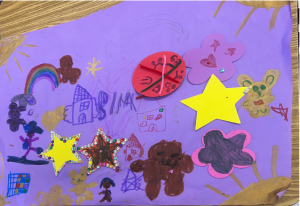
Beyond the “love boxes,” other students created art murals and video/multimodal protest videos where students spoke up against injustices related to human rights (e.g. water, food, shelter). These projects supported the teachers and I in recognizing the innate ability for young children to engage in caring practices, and that young children can use their understanding of care and empathy to engage with “difficult” topics related to social justice.
 Overall, I am so grateful for the opportunity to truly partner with these teachers as community members to engage in projects that support their school. With the support of HEX program, we were able to co-design lessons and provide resources and materials for the children to demonstrate their understandings of community through activist projects. I believe that the collaborative nature of this project, including centering the teacher’s ideas and voices as knowledgeable, shows how much more meaningful and beneficial research projects can be for the community when we as researchers/scholars see our community partners and fellow researcher/scholars as well.
Engaging in public humanities means doing work that centers and uplifts communities as knowledgeable, while recognizing how power imbalances and inequities are harming certain communities. I believe it is important as a public humanities scholar to always be engaging in work that is bettering communities, while supporting those in the community to do this work too!