Launched in 2005, Great World Texts in Wisconsin connects high school teachers and students across the state with scholars at UW-Madison through the shared project of reading and discussing a classic piece of world literature.
What is Great World Texts in Wisconsin?
Drawing from world literature throughout the ages, the program’s selection of texts reflects a capacious understanding of the idea of the “literary classic.” In previous years, we have collaborated with high schools on texts associated with mid–twentieth
century Colombia, ancient Greece, and contemporary India.
The program provides schools with complimentary copies of the text and includes a colloquium during which participating teachers work with UW-Madison faculty members on interpreting and understanding the text, extensive supporting curriculum materials, and a stipend to participate in the Great World Texts Annual Student Conference during which students from all participating schools come together to share their creative responses to the text and hear from distinguished speakers, often including the text’s author or contemporary representative. Now moving into its twenty-second year, Great World Texts has reached tens of thousands of students and teachers in dozens of school districts throughout the state of Wisconsin.
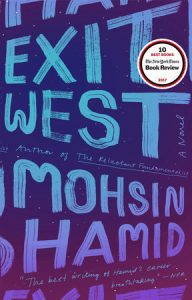 Exit West in Wisconsin
During the 2026-2027 Great World Texts in Wisconsin program, high school teachers and students throughout the state will read Mohsin Hamid’s Exit West, one of The New York Times’s 100 Best Books of the 21st Century, finalist for the Booker Prize, and winner of the L.A. Times book prize for fiction.
Exit West is an astonishingly visionary story that imagines the forces that drive ordinary people from their homes into the uncertain embrace of new lands. In a country teetering on the brink of civil war, fiercely independent Nadia and gentle, restrained Saeed are cloistered in a premature intimacy by the unrest roiling their city. When it explodes, turning familiar streets into a patchwork of checkpoints and bomb blasts, they begin to hear whispers about doors—doors that can whisk people far away, if perilously and for a price.
As the violence escalates, Nadia and Saeed decide that they no longer have a choice. Leaving their homeland and their old lives behind, they find a door and step through…Exit West follows these remarkable characters as they emerge into an alien and uncertain future, struggling to hold on to each other, to their past, to the very sense of who they are. Profoundly intimate and powerfully inventive, it tells an unforgettable story of love, loyalty, and courage that is both completely of our time and for all time.
Participating in Great World Texts in Wisconsin
Teachers participating in Great World Texts will receive a curricular guide for Exit West and a classroom set of texts for their school’s permanent collection. The curriculum guide contains contextual and lecture materials, suggested readings, close reading and discussion activities, handouts, and suggestions for student projects. This curricular guide is designed to make the text accessible for a range of learners and grade levels and is customizable to meet the needs of a wide range of classrooms and students.
Participating teachers from across the state of Wisconsin also attend a virtual educator colloquium, to be held on Monday, August 17, 2026, which will feature lectures by campus faculty, guidelines for the conference, and community building exercises between educators.
Educators will bring their students to UW-Madison for a full-day conference on Monday, April 5, 2027, where students will present projects created in response to the novel, engage with other students from across the state, and meet author Mohsin Hamid in person. All participating educators received a stipend to fund their school’s participation in Great World Texts. These funds are most often used to offset the costs of substitute teachers and bus travel to Madison for the student conference.
If you have questions, please contact Assistant Director, Public Humanities Programs, Danielle Weindling at greattexts@humanities.wisc.edu.