
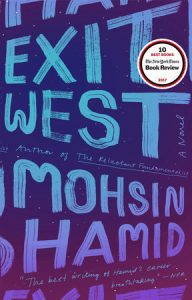
 Presented in partnership with Wisconsin Book Festival. Moderated by B. Venkat Mani, Evjue-Bascom Professor in the Humanities.
In this engaging Humanities Without Boundaries conversation, author Mohsin Hamid will talk about his recent and upcoming works as well as his writing process. Following the conversation, books will be sold on-site by A Room of One’s Own and are available for signing.
Exit West is the 2026–2027 selection for the Great World Texts in Wisconsin program, in which teachers and students from 22 high schools across the state of Wisconsin will read and engage with Hamid’s novel. On April 5, 2027, these students convene on campus to connect with one another, share the projects they created in response to the novel, and meet the author.
Exit West in Wisconsin, an initiative of the Center for the Humanities at the University of Wisconsin-Madison, is supported by the UW-Madison Libraries; the Center for South Asian Studies; the Evjue Foundation; the Wisconsin Book Festival; the Cleary-Kumm Foundation, Inc.; the Brittingham Wisconsin Trust; and the Anonymous Fund of the University of Wisconsin-Madison.
About the Text
Exit West is an astonishingly visionary story that imagines the forces that drive ordinary people from their homes into the uncertain embrace of new lands. In a country teetering on the brink of civil war, fiercely independent Nadia and gentle, restrained Saeed are cloistered in a premature intimacy by the unrest roiling their city. When it explodes, turning familiar streets into a patchwork of checkpoints and bomb blasts, they begin to hear whispers about doors—doors that can whisk people far away, if perilously and for a price.
As the violence escalates, Nadia and Saeed decide that they no longer have a choice. Leaving their homeland and their old lives behind, they find a door and step through…Exit West follows these remarkable characters as they emerge into an alien and uncertain future, struggling to hold on to each other, to their past, to the very sense of who they are. Profoundly intimate and powerfully inventive, it tells an unforgettable story of love, loyalty, and courage that is both completely of our time and for all time.
 About the Author
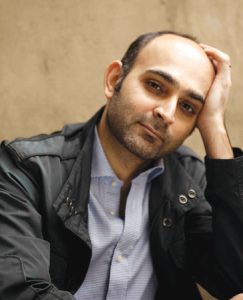
Mohsin Hamid was born in 1971 in Lahore. He grew up mostly in Pakistan but spent part of his childhood in California and returned to America to attend Princeton University and Harvard Law School. He then worked in New York and London as a management consultant before returning to Lahore to pursue writing full-time.
He published his first novel, Moth Smoke, in 2000. Structured like a trial, with the reader cast as judge, it told the story of an ex-banker and heroin addict in contemporary Lahore. It became a cult hit, was adapted for television in Pakistan, and was hailed by the New York Review of Books as “one of the first pictures we have of that world,” a new South Asia “taken over by gun-running, drug-trafficking, large-scale industrialism, commercial entrepreneurship, tourism, new money, nightclubs, boutiques.”
His next novel, The Reluctant Fundamentalist, was published in 2007 and recounted a Pakistani man’s encounter with an unnamed stranger as he tells of his abandonment of his high-flying life in New York in a time of conflict and mutual suspicion. The Guardian named it one of the books that defined the decade and the BBC selected it as one of the 100 novels that have shaped our world. It became an international bestseller, and was adapted into a film by director Mira Nair, starring Riz Ahmed, Liev Schreiber, Kate Hudson, and Kiefer Sutherland.
In 2013 he published his third novel, How to Get Filthy Rich in Rising Asia, which was a love story and an exploration of mass-urbanization and global economic transformation — in the apparent guise of a self-help book. Reviewing it in The New York Times, Michiko Kakutani wrote: “Mr. Hamid reaffirms his place as one of his generation’s most inventive and gifted writers.”
His fourth novel, Exit West, published in 2017, investigated the universality of migration through the story of two refugees fleeing a war-torn city in a world where billions of people have begun to travel through inexplicable black doors. It was an international bestseller described by The New Yorker as “instantly canonical.”
Mohsin’s essays have appeared in The New York Times, The Guardian, The New Yorker, The New York Review of Books, the Financial Times, and many other publications. A book collection of his non-fiction writing, Discontent and Its Civilizations: Dispatches from Lahore, New York, and London was published in 2015.
His writing has been translated into 40 languages and won numerous prizes. He has lectured at dozens of universities around the world, from Harvard, Princeton, Stanford, and Yale to the London School of Economics and the National University of Singapore. In 2013, Foreign Policy magazine named him one of the world’s 100 Leading Global Thinkers.
About the Moderator
Venkat Mani is Professor of German and World Literatures, former director of Center for South Asia, and currently the Alexander von Humboldt Foundation’s Reimer Lüst Fellow (2025-26) at the German National Literary Archives(DLA-Marbach). He is the author of Cosmopolitical Claims: Turkish German Literatures from Nadolny to Pamuk(University of Iowa Press, 2007) and Recoding World Literature: Libraries, Print Culture, and Germany’s Pact with Books (Fordham UP, 2017; winner of German Studies Association’s DAAD Prize and Modern Language Association’s Aldo and Jeanne Scaglione Prize for Best Book in German Studies 2018). Mani has edited or co-edited several volumes including the Journal of World Literature’s Of Homes and Worlds: David Damrosch’s Comparative World Literatures (2024), German Quarterly’s Forum “World Literature: Against Isolationist Readings” (2021), and A Companion to World Literature (Wiley Blackwell 2020).
He’s published widely in many academic journals in the fields of World Literature, German Studies, Comparative Literature, South Asian Literatures, Migration and Refugee Studies, and Book- and Library Histories. His public humanities essays can be read in in Inside Higher Ed, Telos, The Wire (Hindi), The Hindustan Times, and The Indian Express. He serves on the editorial board of Das Jahrbuch der Deutschen Schillergesellschaft, and the advisory board of Cornell University Press’s series Signale Mani is currently working on a monograph on refugees and the global novel.
Mani’s first passion is teaching and mentoring, for which he has won several student-nominated awards. His undergraduate courses include “Global Migrants & Refugees” and “Global Readers in a Digital Age.” His graduate seminars include the interdisciplinary Exile, Asylum and Migration taught through the Center for German and European Studies and seminars on comparative world literature. He has mentored undergraduate and graduate students from several fields in the Humanities and Social Sciences. He has regularly offered seminars at Harvard’s Institute for World Literature.
Mani has received research fellowships and grants from the Social Science Research Council; the Andrew Mellon Foundation’s Sawyer Seminar Grant; the Alexander von Humboldt Foundation’s Experienced Researcher Fellowship; the US Department of Education’s Title VI Grant for Center for South Asia; and a DAAD grant for UW’s Center for German and European Studies. In 2018, he was a residential fellow at ZfL Berlin and in 2022 a Marbach, Weimar, Wolfenbüttel (MWW) Research Fellow at DLA Marbach. He was the Race, Ethnicity, and Indigeneity Senior Research Fellow at the at the Institute for Research in the Humanities (2021-2025). Mani has served on numerous Diversity, Equity, and Inclusion committees on campus and nationally. He was one of the Diversity Liaison Fellows for the Office of UW Diversity and the Vice Provost for Faculty and Staff (2019-21), and a friend-mentor for the Mercile J. Lee Scholarship Program (2021-22). He also served on the Faculty Committee of the L&S Honors Program and the University Research Council.
Affiliated Departments: Department of English; Center for South Asia; Center for German and European Studies; Center for the History of Print and Digital Cultures
update
headshot or no?